Showing posts with label bbq blog. Show all posts

Tuesday, May 6, 2014

May is National BBQ Month. But It's Really Every Month.

By Dru Chai

The folks over at HPBA (Hearth, Patio, and BBQ Association) have made it known to the world that May is National BBQ Month. Why May, you ask? Well, Memorial Day weekend has traditionally been the official kick-off to the summer season. But chances are, if you're reading this blog -- it really doesn't matter what month of the year it is. Every month is BBQ month, in my book!

My smoker, also affectionately known as R2D2-BBQ

Did you know? Out of 80% of American households who own a grill or smoker, 60% use their grill/smoker year-round.

Check out some of these other fun facts (according to HPBA):

Having More Than One Grill for Year-Round Cooking. In North America, nearly 40% of barbecue owners have more than one grill, with 8% owning three or more. In fact, 29% of grill purchases in 2013 were in addition to a previously owned grill.

Barbecuing for Any Holiday. Holidays continue to be a popular time for grill usage. While summer holidays like 4th of July (68%), Memorial Day (52%), Labor Day (51%) and Father's Day (45%) continue to be the most popular for outdoor cooking, holidays like Super Bowl Sundays (31%), Thanksgiving (15%) and New Year's Eve/Day (15%), saw an increase from the same study in 2011.

Food Outdoors Tastes Better Any Time of the Year. When asked why they cook on the grill, 61% of consumers said they prefer the taste of grilled food.

What to BBQ 365. With so many consumers BBQ'ing year-round, here's what they are commonly putting on the grill: hot dogs (72%), steak (71%), burgers (69%), chicken (64%), ribs (50%), sausage/bratwurst (44%), corn (44%), pork chops (43%), potatoes (39%), beef/pork roast (34%) and fish (28%).


Smoky and meaty goodness in a bun

The BBQ industry had another strong year in 2013, with shipments of grills and smokers almost reaching 14 million consumers. Gas grills (58%) continue to be the most popular, followed by charcoal (40%) and electric (2%).

If you're a BBQ and grilling enthusiast like myself, check out these materials courtesy of HPBA:

So what do I make of all this? That the BBQ industry is a multi-billion industry... that's with a "B." With record sales, the industry sure isn't showing any signs of slowing down -- and that's a good thing for everyone. 


Monday, April 2, 2012

ACM BBQ Throwdown in Vegas & What is Considered "Bad" Competition BBQ?

By Dru Chai

Las Vegas hosts plenty of conventions and trade shows, so it was a no-brainer that a BBQ competition be thrown into the mix. Promoted by Smoke on the Water, the ACM BBQ Throwdown was part of a weekend full of festivities leading up the ACM (Academy of Country Music) award show. It's only natural to see country music and BBQ teaming up together. Of course, the total prize of money of $50k helped draw over 100 teams from around the country.

I'm not much of a country music fan, but I just couldn't resist making the 3.5 hour drive to Vegas to judge some top-class BBQ. I was able to squeeze in as one of the last judges. If I couldn't go, well, I'm sure it would've broken my "achy breaky heart."


The parking lot of the Mandalay Bay was a nice location for the competition. There was plenty of wide open space, and the BBQ smoke filled the air (when it wasn't windy). Combine that with sunny 80+ degree weather and free admission, I was actually surprised that there wasn't a bigger crowd.


Other than eating and drinking, there was plenty of "country" related entertainment -- country line dancing, mechanical bull riding, and even lassoing. I was hoping Carrie Underwood would show up as a last minute surprise performance, but of course that didn't happen. 


After getting over the initial excitement of judging my first contest in Santa Anita a few weeks ago, I had a better "feel" of what to expect the second time around. Not that I have years of experience or dozens of contests judged under my belt, but my BBQ judging taste buds are getting a good workout. Obviously, BBQ judging is subjective and everyone is different, but everyone is generally in the same ballpark when it comes to what is good or "bad" competition BBQ. The regions also matter too -- west coast judges tend to like spicier, bolder flavors, while the east coast favors the mellow and traditional flavors.

Here are my thoughts, and my thoughts only:

Chicken - In competition BBQ, chicken thighs not only have to be juicy and flavorful, but have "bite-through" skin as well. Smoking meat generally produces tough, leathery, and rubbery skin. Judges typically take one bite, so you don't want the skin to completely slide off. That skin has to be edible and taste good too. Every team has their own secret or tricks of the trade when it comes to treating chicken thigh skin.

Ribs - Most ribs that I've judged look fairly identical upon first glance, but that completely changes after the first bite. Ribs present the best opportunity for that "blank canvas," as most teams try to provide their own distinct and unique flavor -- whether it's the rub or the sauce. Most judges I've talked to seem to be like their ribs on the sweet side.

Pork - This category is the one that many teams have trouble with appearance, which is open to interpretation. Unlike the other categories, pulled pork meat can be presented in different ways within that styrofoam box -- in all shapes and sizes. When it comes to texture, I find that a lot of samples are mushy and overcooked, which is easy to do with pulled pork. 

Brisket - Everyone agrees that brisket is the toughest category in terms of tenderness. But the taste and flavor of brisket varies so widely with each team. Some teams may opt to use a certain type of injection, which just stands out. Some judges may like it, and some don't -- it all depends. For me, I like brisket to taste natural and smoky, and not have any weird and distinct off taste. One judge said to me, "beef should taste like beef." Amen to that!

Sunday, February 26, 2012

Insider's View of a Certified BBQ Judging Class

By Dru Chai

I'm not gonna lie. As I mentioned before on this blog, a big reason of why I wanted to become a BBQ certified judge was for the free food. I mean, who wouldn't be excited for that? If you eat, breathe and sleep BBQ, free food has to be on the top of the list. Heck, BBQ is expensive!

But as I sat through 10 hours of BBQ judging class at the NBBQA Conference & Trade Show in San Diego, I realized something. I realized that the world of BBQ competition is serious business. When I mean serious, I'm referring to everyone's passion, love, and dedication for BBQ.

The NBBQA Conference rarely happens in SoCal

As a certified BBQ judge, I want to make sure that I'm judging each piece of BBQ meat with fairness and equality. There is no such thing as a BBQ expert. Everyone has different taste buds, and their own idea of what constitutes good BBQ. BBQ judges take their "job" seriously and look that way on the outside, but make no mistake -- I'm doing a happy little dance inside each time I taste a tender, flavorful, and mouth-watering piece of BBQ.

So how was the BBQ conference and the judging classes? Well, I consider myself lucky. Both judging classes and the conference rarely make an appearance in Southern California. So I had to take advantage. Since both classes took up the entire day, I didn't get a chance to check out some of the other how-to presentations, guest speaker seminars, or the trade show. I barely had a chance to taste some BBQ, but this one was clearly my favorite.

Neil "Bigmista" Strawder serving up some pulled pork
Flavorful and tender pulled pork from Bigmista BBQ
That BBQ sauce was da bomb

MBN Judging Class Overview

Memphis Barbecue Network competitions is all about the swine -- judges blind taste test pork shoulder, ribs, and whole hog. What sets them apart from others is that there is on-site judging as well. This means they get to visit and talk with the cooks and pit masters in person, who have the opportunity to explain their cooking methods and present their food personally to the judge. We went through two demonstrations to get a feel of what it would be like.

Showing what pork shoulder is all about to a "test judge"
Pork shoulder goodness, the money muscle
Some teams will show their sauce and rub, but it's all about the meat
The class was small in size at around 20 people, and understandably so. After taking the class, we were only MBN "trained." We only become officially certified once we judge 3 competitions. MBN sanctioned competitions rarely occur on the West coast, so finding one in Southern California will be tough. Chances are, I'll probably be just an MBN trainee for a while.

KCBS Judging Class Overview
Kansas City Barbecue Society competitions occur all over the country, and quite a few of them take place up and down California. So I knew this was going to be a popular class -- there was about 60 people in attendance, jam-packed in rather small conference room. Many in attendance were BBQ teams, wanting to know more about the judging process, so they know what to look for when putting out their BBQ during competitions.

Getting ready to do some practice judging
Pulled pork category, not so good... but it's practice

This class was definitely a lot louder than the smaller MBN class. After going through a presentation, we were presented with BBQ samples from each category (pulled pork, ribs, chicken, and brisket) for our own judging session. Unlike MBN, there is only blind judging for KCBS competitions. There are a few things to look for that could disqualify an entree, so they purposely threw in some screwballs to test us. I'll definitely be looking to judge as many KCBS events as possible!

Lining up for some BBQ samples
Now that's old school
Just don't BBQ his pet

Monday, January 16, 2012

Certified BBQ Judge? I Like The Sound of That!

Yup, I'm still here. I know it's been a while since I've posted on this blog, but honestly there just hasn't been anything interesting to write about. I'm not one to babble just for the sake of babbling. But I do want to give a huge thanks to those who have ordered from my little catering business on the side. You know how there's a lady that sells tamales at work? Well, I'm the dude that sells brisket at work. I've sold pulled pork, ribs, and chicken, but the brisket has been the hot seller by a landslide. Thus far, I've done about 30 orders and it's been a blast.

I drool every time I look at this picture
Dirty Smoke BBQ brisket is always a favorite

If you've been a reader of this BBQ blog, you'll know that I'm constantly trying to learn new things. There are so many great BBQ websites out there that give you how-to instructions, videos, and all types of info. Of course, that isn't my goal here. Although, I don't want to be seen as a BBQ expert, I'll still share my experiences (good or bad). As we kick off the new year, I want to make an effort to chronicle more BBQ experiences outside of the backyard -- whether it's writing about restaurants, products, or events.

So what's first up this year? Back in June '11, I wrote about wanting to attend a certified BBQ class. Well, that time has arrived. I just signed up for not just one, but TWO certified BBQ judging classes on February 25 in San Diego. It's part of a BBQ convention organized by the NBBQA (National BBQ Association). If you're new to the BBQ world, there are quite a few acronym-loving BBQ organizations out there. It can be hard to remember and keep track of them all. One of the classes is by the MBN (Memphis BBQ Network) and other is by KCBS (Kansas City BBQ Society).

So what's the difference between the 2 classes? Well, they both judge different meat categories. KCBS is the most popular one that sanctions a lot of competitions and probably most people know about -- they judge ribs, chicken, pork shoulder, and brisket. The MBN judges whole hog and pork shoulder only. I could write more, but Professor Salt from the Grill Marks blog over at OC Weekly explains it in more detail. Of course, all this BBQ fun doesn't come cheap. Each class costs $90. But once I become certified, hopefully I'll more than make up for it by eating lots of "free" BBQ at competitions. Oh and yeah, that BBQ competition knowledge will help too.


Friday, November 25, 2011

How to Smoke Turkey for Thanksgiving

There's nothing better than spending time with friends, family, and... a 12-lb smoked turkey. As I mentioned in my previous post, I had been looking forward to making smoked turkey for the first time. With leftovers neatly packed in tupperware, I can still smell the slight whiff of apple wood smoke. So was my first attempt at smoked turkey a success? How did it taste? What would I do differently?

Turkey brined for 12 hours
My 12-lb brined turkey getting ready to go under

I've read all the various ways of preparing a smoked turkey -- whether to wet-brine, dry-brine, no-brine, inject, etc. Since this was my first time, I decided to try a little bit of everything. I submerged the turkey into a brining solution with some:

- Apple juice
- Brown sugar
- Kosher salt
- Honey
- Oranges
- Peppercorns
- Garlic
- Bay leaves

Since I read that brining can cause the turkey to taste a bit "mushy," not to mention take away some of that meaty flavor, I decided to just brine the turkey for about 12-15 hours. I patted the turkey nice and dry, then gave it a good massage of olive oil and seasoning rubdown which included the following:

- Seasoned salt
- Black pepper
- Garlic powder
- Paprika
- Cayenne

For good measure, I also injected the turkey with the star ingredient -- Corona beer!

- 1 bottle of Corona
- Melted butter
- Paprika
- Cayenne

After 3 hours of smoking in the WSM
I had about 3 plates!

After 3 hours of smoking the turkey in the WSM (with 2 fist-sized apple wood chunks), the turkey came out with a nice, mahogany colored skin crust. When I measured the temperature of the breast, it was around 170-175 degrees F. Since I was targeting the magic number of around 160-165, I was afraid the breast meat would be too dry. Next time, I will need to check the temperature a bit earlier (I got caught up finishing the side dishes!).

After letting the turkey rest for about a half hour, I sliced the turkey wide open. The breast was still reasonably moist. The slight hint of smoke was perfect -- not overpowering at all. The dark meat was full of flavor too. I used the pan drippings to make the gravy and it was the perfect compliment to the turkey. For my first time smoking turkey, I thought everything tasted great.

The one thing I noticed (and knew from the start) was that the skin wasn't as extra crispy (compared to an oven cooked turkey) --which was a result of the lower smoking temperature. From the start, I tried to maintain a temperature in the WSM of at least around 325-350 for all 3 hours, but it was a challenge. I would say the average temperature was more like around 300. Other than that, I thought my first time smoking a turkey was a success. I'll be smoking turkey more often in future years, and hope to get better.

Friday, November 18, 2011

Happy (Smoked) Turkey Day!

Of course, you knew it was going to happen. This year, I'm going to smoke a turkey for the very first time. I've always eaten turkey the traditional way--cooked in a conventional oven. More often than not, the turkey came out dry and flavorless. I would always have to drench the turkey in gravy to make it taste better. Nowadays, it seems that fried turkey is all the rage. And no, I'm not going anywhere near a turducken. Of course, you can always get one of those monstrous, mutant-sized turkey legs from Disneyland all-year round. Did you know one of those turkey legs has about 1,000 calories?!

$9 for a turkey leg at Disneyland... please look away, don't judge!
"Pardoned" turkey at Disneyland... which means he's lucky.

Smoked turkey just seems healthier and easier--well, for me anyway. I've already got my beloved smoker, which has been used about 20 times since I bought it in May. The smoker is already properly seasoned, which means all the months of grease build-up within the smoker will help regulate the temperature and give it that added smoky flavor versus a brand new smoker out of the box. I've done some research online about smoking turkeys. Just Google "smoked turkey recipe" and you'll find plenty of results.

Some of my favorite recipes and articles about smoked turkey come from Serious Eats (one of my favorite food websites out there). Here are 3 variations:

Cajun Smoked Turkey

Apple-Brined and Smoked Turkey

Honey Brined and Smoked Turkey

Of course, the always reliable and informative Virtual Weber Bullet (aka, the bible of WSM smoking) has some very detailed step-by-step instructions for smoking a turkey:

Apple-Brined Turkey
Honey-Brined Turkey
Salt-Brined Turkey

My 12 lb turkey waiting to be injected, brined, and smoked.

After reading quite a few recipes, I'm going to use a little bit of everything for a "hybrid" smoked turkey--both using both methods of marinade injecting and brining. I know it may be overkill to do both, but why not? I don't want the typical turkey flavor--I want bold flavors with a little kick with every bite. I want a ultra-juicy turkey breast with extra crispy, golden brown skin. I know--for a first-time turkey smoker, I've got super high expectations. I'll let you know how it all turns out next week. In the meantime, have a great Thanksgiving holiday!

Monday, November 7, 2011

How to Cook and Prepare Rib Tips

By Dru Chai

In my younger days of eating BBQ, I've always wondered what rib tips were. Did people just take a rib and chop the tips off? Why would they do that--wouldn't the entire rib taste much better? Or are they simply mini-versions of a rib? Well, it's none of the above, of course. They are the leftover "scraps" after trimming a rack of spare ribs, thereby transforming them into a uniform-shaped St. Louis Style ribs.

So what do you do with these rib tips? Some people just toss them away into the garbage. Feed them to the dogs. Dry them up to make pork jerky. Or maybe even collect enough of them to make a porky meat dress out of it (click here for inspiration). Hey, the possibilities are endless and only limited to your imagination.

Rib tips still have some cartilage and good amount of meat. Since I hate to see food go to waste--even if it is the bastard-child of the almighty bone-in pork rib--might as well do something with it. Once you've trimmed away all of the fat, you can throw the rib tips in a slow cooker. You could season it first, brown it on all sides on the skillet or pan, then add some vegetables later on.

Here's what I did--I took both rib tip flaps and a few trimmings, seasoned it liberally, then wrapped it up in heavy duty aluminum foil. You can even pour in some apple juice or marinate inside the foil before wrapping it up. That way, it will give some added moisture and the juices will steam the meat--making it nice and tender. Throw in in the oven for about 3-4 hours at 225-250 degrees (low and slow, you don't want to be making leather shoe strips here).


The result should be some fork-tender pork meat--the texture is a bit similar to pulled pork (shoulder), but it still has some of that meaty rib flavor. When the rib tips cooled down, I simply used my hands to pull apart all the chunks of meat, getting rid of any huge clusters of fat and cartilage. Take the meat and make a rib-tip sandwich, throw it on top of a salad, or simply dip with your favorite BBQ sauce.

As an added bonus, I also drained some of the natural meat juices ("meat juice," now there's a phrase of the day) into a separate bowl. Don't waste it--use it for just about anything to infuse some pork flavor. I used it as base for my homemade BBQ sauce. I'll have to save that for another post.

Tuesday, November 1, 2011

How to Make BBQ Pulled Pork

By Dru Chai

Pulled pork probably doesn't get as much love from its bony companion--the ribs. After all, ribs are eaten with your hands, it's messy, and you can get it all over your face. Plain and simple, it's just a good time to eat ribs, and it just epitomizes what BBQ is all about. But don't overlook pulled pork. It's incredibly versatile, cheaper in price, and can serve a lot of people.

Pulled pork is easy to make--commonly eaten as a sandwich, either on a soft bun or roll. You see variations of pulled pork in all different cultures--for example, Mexican carnitas, and Hawaiian kahlua pork. Most people simply make their pulled pork in a good slow cooker. Basically, set it and forget it. But there's nothing that substitutes good 'ol fashioned low-and-slow, smokey flavor over 8-12 hours. You just can't replicate that smokiness and the pieces of char on the outside.


One day, I hope to visit North Carolina for some authentic pulled pork, but for now, I'll just have to make my own backyard rendition at home. For the past several months (as documented on this BBQ blog), I've honed my BBQ smoking skills mainly on brisket and ribs. With a few parties and potlucks waiting in the wings, I decided it was time to try my luck at pulled pork. Here's the breakdown for my smoked pulled pork sliders with sweet and crisp coleslaw.


I went to my local Costco and found the smallest pork butt I could find--a little under 13 lbs overall, at $1.89/lb. With the name pork "butt," one might think it is from the buttocks of a pig. But it's only a name -- pork butt is actually pork shoulder.


The next step is injecting the pork butt with a good marinade injector. Not only does it help produce juicy and tender meat, but injecting just gives that added depth of flavor with every bite. Everyone has their own concoction of what should go in the marinade, and I'm sure BBQ competition teams closely guard their recipes. It all depends on the flavor profile--if you want sweet, salty, spicy, etc. One thing's for sure, you want a balanced marinade. I used something like this, which serves as a nice base.

- Apple juice
- Vinegar (or apple cider vinegar)
- Salt
- Sugar
- Hot sauce


Next up, the rub. Just like with the marinade, you have to balance out the salt and sugar, then incorporate spices depending on what you like. If you want flavorful pulled pork, it's best to let it sit in the fridge for 24 hours so that all the spices and marinade get to know each other. Or, you can always be lazy and buy a pre-made rub mix.

- Kosher salt, or seasoned salt
- White sugar, or brown sugar
- Granulated garlic or garlic powder
Optional: Chili powder, cayenne, onion powder, cumin


When ready, fire up the Weber Smoky Mountain using the Minion Method so that it's around 225-250 degrees. I like to use either hickory, oak, or apple wood. Depending on your taste buds, you can go heavy on any particular wood. You can't go wrong with hickory--about 4-5 fist-sized chunks will do. Close the lid, then go read a book, watch the Simpsons marathon, knit a sweater, or whatever it is that you like to do for the next 5-7 hours.

At this point, you deserve a peek. Open the lid and see how everything looks. You should get a nice bark forming on the outside--crusty, charred, and black. If you've been reading this BBQ blog, you know that I'm a huge proponent of a good bark on my BBQ. Depending on your preference, you can spray some water or apple juice. Close the lid, and return in another hour or two.

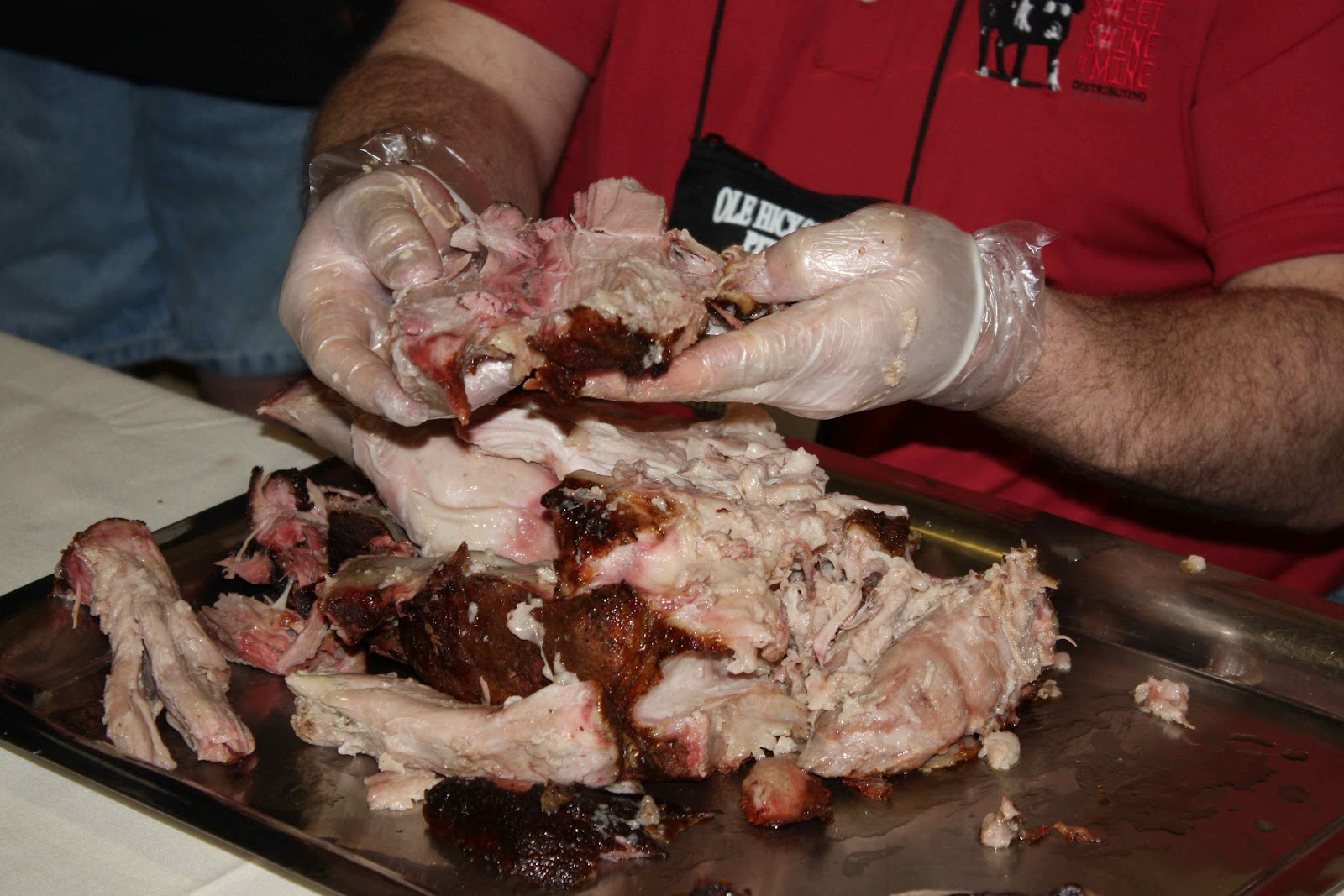
With a good thermometer, check if the internal temperature is 195 degrees. If so, it's ready to be pulled out from the smoker. Let it rest for at least 20-30 minutes, so that all the juices re-distribute inside, then the fun part begins. Take some regular forks, those "bear paw" looking forks, or a clean set of hands and go right at it. The pulled pork should be juicy, tender, and full of porky and smoky goodness. Accompany with a good, vinegar-based (a bit of sweet and tangy) BBQ sauce, and you're all set to go to hog heaven.


Friday, October 28, 2011

Dirty Smoke & Party Rock Tebowing

In the spirit of Halloween, love for BBQ, and the latest Internet craze...

Updated: I made it on the "official" Tebowing website. LOL!

Yes, those are purple pants

Monday, October 24, 2011

What's a Minion Method?

By Dru Chai

Photo and stoic-faced minion courtesy of Universal Pictures

No, not that Minion (although those guys always crack me up in the movie).

If you're just starting out BBQ smoking, you might have heard of the term "Minion Method" once or twice. If you're already familiar with the term and have used the method, you know that it's far superior to what the manual tells you to do (if you're a Weber Smokey Mountain owner). If you're serious about smoking your own BBQ and you've read about it on this blog, you definitely know the Minion Method.

The Minion Method is basically a way of setting up the charcoal so that it burns longer, more steady, and more consistent. In general, you won't have to keep adding more fuel during the cooking process, so it's perfect for overnight cooking sessions. To top it all off, you can start cooking relatively quickly. If done correctly, it should last anywhere from 6-18 hours at around 225-275 degrees F--perfect for the low and slow meats like brisket and pulled pork. The Minion Method is not meant for smoking at temps of higher than 300 degrees F.

Basics of Setting Up the Minion Method:
  1. Fill the WSM charcoal chamber to the top with unlit charcoal briquettes
  2. Spread several fist-sized chunks of wood at the bottom (and/or the top) of the charcoal
  3. Fill the chimney starter about halfway with charcoal, light up
  4. When the burning charcoal starts to turn white ash, dump on top of the unlit charcoal
  5. Voila, there you have it. The Minion Method.
Now of course, as in the case of BBQ Philosophy (as I like to call it on this blog), everyone has their own ways of doing things. I like to put a few chunks of wood on top of the charcoal, because I feel that the wood flavor penetrates the meat a lot more at the beginning stages vs. towards the end of the smoking process. Since charcoal is relatively cheap, I much rather put more charcoal at first vs. having to end up re-filling down the line.

As he explained in his class, Harry Soo from Slap Yo Daddy BBQ likes to make a "crater" with this Minion Method. He piles as much charcoal on the sides, almost playing a little game of balance, while leaving a hole in the middle. Then he fills the hole with fully-lit, ash-colored charcoal. That way, the charcoal slowly burns from the inside out. At the second picture below, the charcoal chamber is pretty much max'd out--so there's plenty of cooking/smoking time with that bad boy.


There are also those with distinct taste buds, who say they don't like the idea of smoking with unlit charcoal because it gives off a weird taste. They also say that it's unhealthy because unlit charcoal briquettes has that chemical taste that needs to be initially burned off (thus turning into the ashy, grey-color). Personally, I've smoked BBQ in all different methods and I really can't tell the difference in taste. That's part of the fun about BBQ -- there is no right or wrong, whatever works for you, just go with it.

Monday, October 10, 2011

Review: Slap Yo Daddy BBQ Pitmaster Class

By Dru Chai

I felt like a giddy grade school kid, eagerly awaiting snack time of graham crackers and milk. Only this time, it was brisket, pulled pork, ribs, tri-tip, chicken... the list goes on. I had waited about 3 months just for Harry Soo's BBQ pitmaster class (and even wrote about it on this BBQ blog), so I sure as heck could wait another few minutes. But after 6 hours of talking BBQ nonstop, I was about to faint. My stomach had been eating itself up.

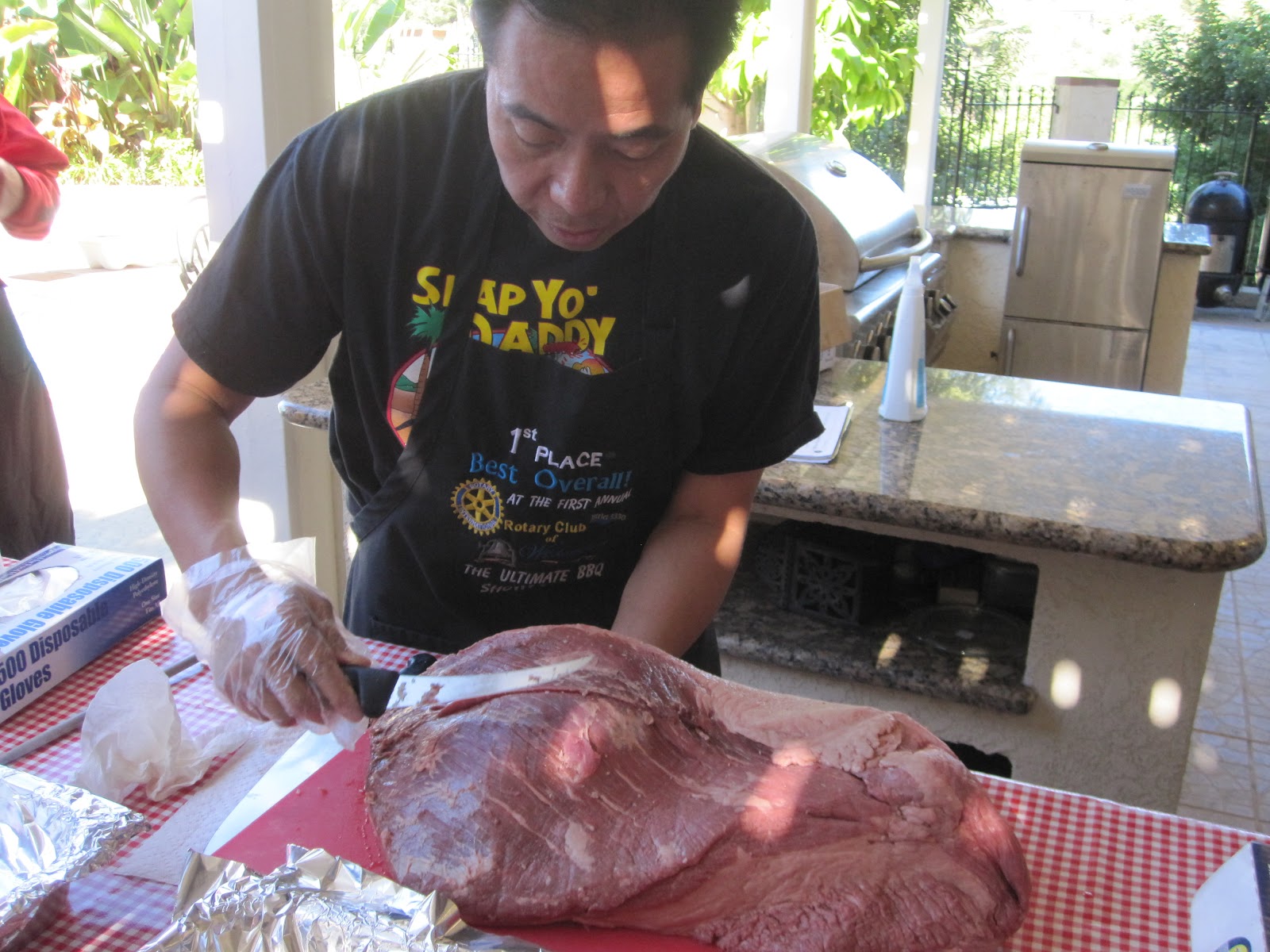
Harry Soo's love for BBQ is infectious. You can feel it by the way he talks about BBQ and his techniques--the way he demonstrates how to properly trim the excess fat from a brisket, the way he shows you how to properly check if the bark has hardened using a fingernail, or the way to properly load up the charcoals using the Minion method. There's a reason why he uses a particular ingredient, and it's through his own research and blind taste tests over the years. In person, he's exactly the way I've seen him on television--humble and willing help anyone out.

Within just a few years, Harry's Slap Yo Daddy BBQ competition team has racked up awards all over the country. I wondered, just how does he do it? For Harry, BBQ is the ultimate stress reliever from the real stress of his day time job. I couldn't agree more--it's just you and your thoughts, the meat, and the smoker. Only this guy travels thousands of miles around the country and enters BBQ competitions to compete against some of the best pitmasters in the world... and wins.

As a BBQ enthusiast and writer of a BBQ blog, I learned a few tips, hints, and tricks. Sometimes, it's the little things that make a big difference. For the BBQ newbie who's just starting out, Harry covers a lot of material in just a short amount of time -- it could be overwhelming, but Harry is easy going and down-to-earth. There are no dumb questions in his class. For those who have had prior experience, the class focuses on techniques for someone who's interested in entering a real BBQ competition. Harry said that many of students go on to enter competitions and end up beating him. Now that's the ultimate compliment.

Ready to spread BBQ joy

Harry really loves his BBQ
Harry showing us how to properly trim the fat off a brisket
Harry's family of WSM's

Harry explaining how to light up his smoker
The Minion method
Using lots of foil is good
Ready to eat what we made - finally!